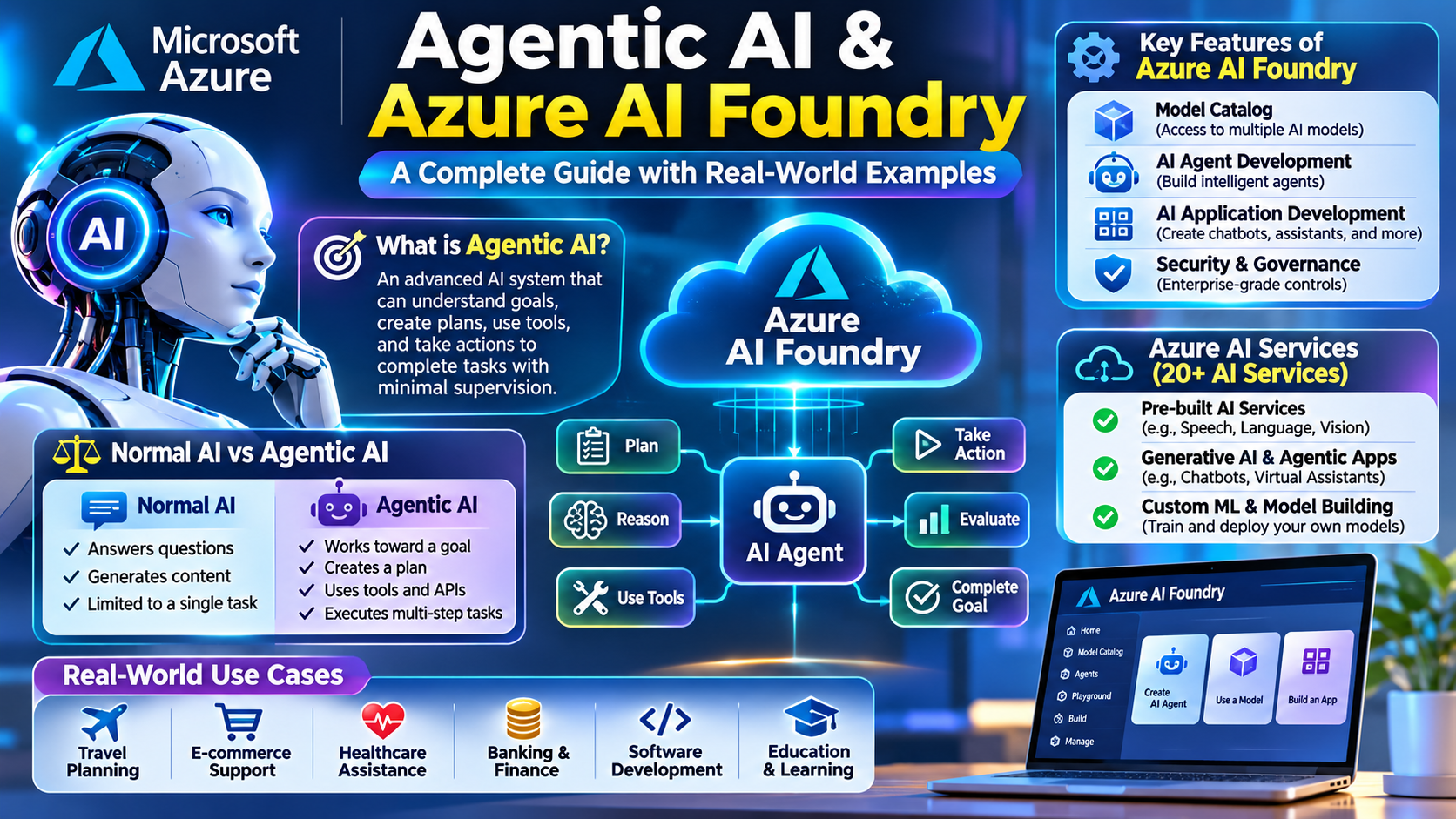
Agentic AI and Azure AI Foundry: A Complete Guide with Real-World Examples
Introduction
Artificial Intelligence (AI) is transforming the way businesses and individuals work. From answering questions and generating content to automating complex business operations, AI is becoming an essential part of modern technology.
Traditional AI systems mainly respond to user instructions, whereas modern AI systems can understand goals, create plans, use external tools, and perform multiple tasks with minimal human supervision.
One of the most exciting developments in this field is Agentic AI.
Microsoft Azure provides powerful AI services and development platforms that help developers build intelligent applications and AI agents. One such platform is Azure AI Foundry (now Microsoft Foundry).
In this article, we will explore:
- What is Agentic AI?
- How does Agentic AI work?
- Difference between Normal AI and Agentic AI.
- What are Microsoft Azure AI Services?
- What is Azure AI Foundry?
- Real-world applications of Agentic AI.
- How to build AI solutions using Azure.
1. What is Agentic AI?
Agentic AI refers to intelligent AI systems that can independently work toward achieving a specific goal.
Unlike traditional AI systems that simply answer questions or generate content, Agentic AI can:
- Understand user goals.
- Break complex tasks into smaller steps.
- Create execution plans.
- Make decisions based on available information.
- Use external tools and APIs.
- Perform actions.
- Evaluate results and adjust its approach.
In simple words, Agentic AI does not just tell you what to do; it can also take action to complete a task.
Real-World Example: Travel Planning
Imagine that you want to plan a three-day trip to Puri, Odisha.
You give an AI Agent the following instruction:
“I want to plan a three-day trip to Puri within a budget of ₹10,000.”
The AI Agent can perform several steps:
- Understand your travel requirements.
- Search for available transportation.
- Find suitable hotels.
- Compare accommodation prices.
- Calculate the estimated travel expenses.
- Prepare a three-day travel itinerary.
- Present the complete travel plan.
If booking or payment is required, the agent should request your confirmation before performing those actions.
This is an example of how Agentic AI can automate multi-step tasks.
How Does Agentic AI Work?
Agentic AI generally follows these steps:
| Step | Description |
|---|---|
| 1. Goal | Understands the user’s objective. |
| 2. Planning | Breaks the objective into smaller tasks. |
| 3. Reasoning | Determines the appropriate actions. |
| 4. Tool Usage | Uses external tools, APIs, or databases. |
| 5. Action | Executes the required operations. |
| 6. Evaluation | Checks the results and adjusts if necessary. |
2. Difference Between Normal AI and Agentic AI
Traditional AI and Agentic AI have different capabilities.
Normal AI
Normal AI generally responds to user instructions.
Example:
User: “Write a Python program to calculate the square of a number.”
AI provides the Python code.
Agentic AI
Agentic AI can perform multiple steps toward completing a goal.
Example:
User: “Create a Python application and test it.”
An AI Agent with appropriate development tools and permissions can:
- Understand the requirements.
- Create the project structure.
- Write Python code.
- Execute the program.
- Identify errors.
- Fix errors.
- Run tests again.
Comparison Table
| Feature | Normal AI | Agentic AI |
|---|---|---|
| Main Purpose | Answer questions and generate content | Achieve specific goals |
| Planning | Usually limited | Can create multi-step plans |
| Decision Making | Primarily response-oriented | Can select actions |
| Tool Usage | May use tools | Can coordinate multiple tools |
| Task Execution | Usually provides information | Can execute actions |
| Human Supervision | Depends on the application | Can operate with limited supervision within defined permissions |
3. What Are Microsoft Azure AI Services?
Microsoft Azure is a cloud computing platform that provides various services for building, deploying, and managing applications.
Azure offers more than 200 cloud services across different technology categories, including computing, networking, storage, databases, security, and artificial intelligence.
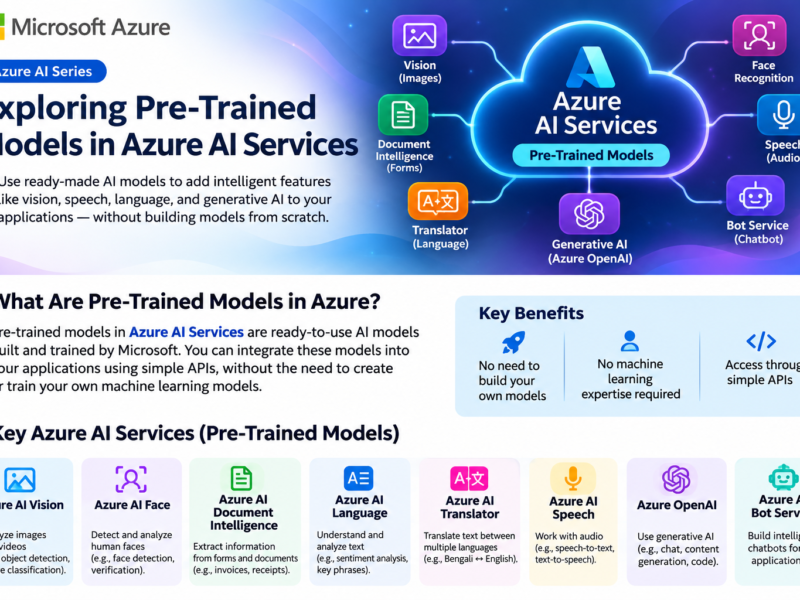
Azure AI services help developers integrate intelligent capabilities into their applications without building every AI component from scratch.
Major Categories of Azure AI Solutions
There are three important approaches to building AI solutions using Azure.
3.1 Pre-built and Managed AI Services
Pre-built AI services provide ready-to-use AI capabilities.
Developers can integrate these services into their applications using APIs and SDKs.
Examples include:
- Speech Recognition
- Language Processing
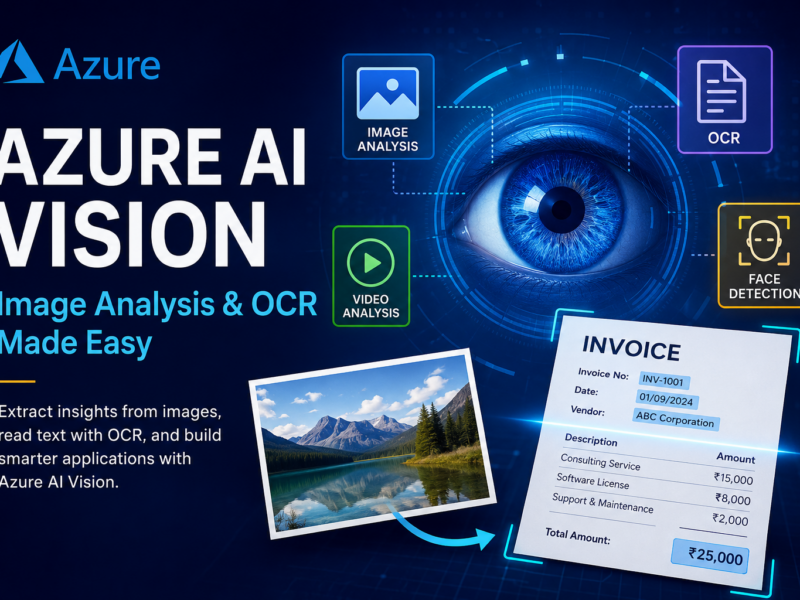
- Image Analysis
- Document Intelligence
Real-World Example:
Imagine you are developing a customer support application.
A customer sends a voice message. An AI-powered speech service can convert the speech into text so that the application can process the customer’s request.
3.2 Generative AI and Agentic Applications
Generative AI creates new content based on user instructions and input data.
It can generate:
- Text
- Images
- Computer code
- Summaries
- Reports
- Conversational responses
Agentic applications extend these capabilities by allowing AI systems to use tools and perform multi-step tasks.
Real-World Example:
A company develops an AI customer support agent.
A customer asks:
“Where is my order?”
The AI Agent can:
- Understand the customer’s question.
- Access the order management system.
- Retrieve order information.
- Check the delivery status.
- Generate a response for the customer.
3.3 Custom Machine Learning and Model Building
Sometimes pre-built AI services are not sufficient for specific business requirements.
In such situations, developers can build custom Machine Learning models using their own datasets.
Example: House Price Prediction
Suppose you have historical house sales data containing:
- House size
- Number of bedrooms
- Location
- Property age
- Previous selling prices
You can train a Machine Learning model using this data.
The trained model can predict the estimated price of a new property based on its characteristics.
This is an example of custom Machine Learning.
4. What is Azure AI Foundry?
Azure AI Foundry, formerly known as Azure AI Studio, is Microsoft’s unified platform for developing, testing, deploying, and managing AI applications and intelligent agents.
It provides developers and organizations with tools to work with AI models, build applications, develop agents, and manage AI solutions.
In simple words:
Azure AI Foundry is a development platform where developers can select AI models, build AI applications, create intelligent agents, and manage their AI solutions.
Important Features of Azure AI Foundry
4.1 Model Catalog
The Model Catalog provides access to different AI models that developers can evaluate and use.
Depending on availability and deployment options, developers can explore:
- OpenAI models.
- Open-source models.
- Other supported foundation models.
Developers can select a model based on their application requirements, performance, and cost.
4.2 AI Agent Development
Azure AI Foundry provides capabilities for developing intelligent AI agents.
An AI Agent can use an AI model, instructions, and connected tools to perform specific tasks.
Example: Customer Support Agent
Imagine an online shopping company wants to automate customer support.
The company creates an AI Agent that can:
- Understand customer questions.
- Retrieve product information.
- Check order details.
- Access approved business tools.
- Generate customer responses.
This reduces repetitive manual work and improves customer service.
4.3 AI Application Development
Developers can use AI models to build different types of applications.
Examples include:
- AI Chatbots
- Virtual Assistants
- Document Analysis Applications
- Business Automation Systems
- Intelligent Search Applications
4.4 Security and Governance
Security is an important requirement when developing enterprise AI applications.
Organizations must ensure that AI applications handle information responsibly.
Azure provides security, monitoring, access management, and governance capabilities to help organizations manage their AI solutions.
5. Practical Example: Building an AI Customer Support System
Let’s understand how Agentic AI and Azure AI Foundry can work together.
Imagine that an e-commerce company wants to develop an intelligent customer support system.
The system should automatically answer customer questions about orders.
System Workflow
Step 1: Customer
The customer asks:
“Where is my order?”
Step 2: AI Agent
The AI Agent receives and understands the question.
Step 3: AI Model
The AI model processes the customer’s request and determines what information is needed.
Step 4: Tool Usage
The agent uses an approved tool or API to access the order management system.
Step 5: Database
The system retrieves the customer’s order information.
Step 6: Generate Response
The AI Agent generates a response based on the retrieved information.
Step 7: Customer
The customer receives the delivery status.
Architecture Flow
Customer
↓
AI Agent
↓
Understand Customer Query
↓
AI Model
↓
Tool / API Integration
↓
Customer Database
↓
Retrieve Order Information
↓
Generate Response
↓
Customer
This is a practical example of an Agentic AI application.
6. Important AI Terminologies
Understanding the following terms is useful when learning Azure AI and preparing for Microsoft AI certifications.
| Term | Full Form / Meaning |
|---|---|
| AI | Artificial Intelligence |
| ML | Machine Learning |
| DL | Deep Learning |
| NLP | Natural Language Processing |
| AGI | Artificial General Intelligence |
| Generative AI | AI that generates new content |
| Agentic AI | AI systems that work toward goals through planning and actions |
| AI Agent | Software that uses AI to perform specific tasks |
| AI Model | A trained computational model used for AI tasks |
| Model Catalog | A collection of available AI models |
| Neural Network | A computational model inspired by the structure of the human brain |
| Governance | Policies and controls for managing AI systems |
7. Real-World Applications of Agentic AI
Agentic AI can be applied across many industries.
Healthcare
AI Agents can help organize medical information, support administrative workflows, and assist healthcare professionals with information retrieval.
Banking and Finance
AI Agents can help analyze financial information, answer customer questions, and automate selected banking workflows.
E-commerce
AI Agents can help customers find products, check order status, and receive personalized assistance.
Software Development
AI Agents can assist developers with writing code, debugging, testing, and documentation.
Education
AI Agents can help students understand subjects, prepare learning materials, and answer educational questions.
8. Conclusion
Artificial Intelligence is evolving from simple rule-based systems to advanced Machine Learning, Deep Learning, Generative AI, and Agentic AI applications.
Agentic AI represents an important development because it allows AI systems to move beyond generating responses and perform multi-step tasks using available tools.
Microsoft Azure provides various AI services and development capabilities that help organizations build intelligent applications.
Azure AI Foundry provides a unified environment for working with AI models, developing AI agents, and building enterprise AI applications.
As AI technology continues to evolve, understanding Agentic AI, Generative AI, Machine Learning, and Azure AI services will be valuable for developers, cloud engineers, and technology professionals.
Learning Azure AI today can help you prepare for the next generation of cloud computing and intelligent automation.
References and Further Learning
For official documentation and hands-on learning, explore:
- Microsoft Foundry Documentation: https://learn.microsoft.com/en-us/azure/ai-foundry/
- Azure AI Services: https://azure.microsoft.com/en-us/products/ai-services/
- Azure AI Documentation: https://learn.microsoft.com/en-us/azure/ai-services/
- Microsoft Learn: https://learn.microsoft.com/